


As the warm, lively days of summer begin to transition into the rich, cool hues of fall, isn’t it the perfect time to plan some earthy adventures? We’ll be your personal guide to exploring the geological marvels that come alive in the magnificent month of September.
September is a time of balance, when the sweltering heat waves of summer start to make way for the crisp, cool breath of autumn. It’s a magical month where the earth seems to stand still, caught between two seasons.
For us, geology lovers, it’s a fantastic time to explore, with comfortable temperatures and stunning fall colors beginning to paint the landscapes!
Imagine wandering through ancient forests, their leaves transforming into a blaze of autumn colors, or exploring rocky coastlines, witnessing the power of the ocean waves. Picture yourself marveling at majestic mountains, their peaks just starting to be kissed by the first snowflakes.
And don’t forget the awe-inspiring geysers, volcanoes, and canyons that tell the dramatic tale of our Earth’s history.
So, are you ready to discover the spectacular geological wonders that September has to offer? Put on your hiking boots, pack your rock hammer, and let’s embark on this journey together!
North Cascades National Park – Washington
This park is like a giant, open-air museum of geological marvels just waiting to be explored. The rugged landscapes here are a testament to the colossal power of the Earth’s natural forces. Picture vast wilderness areas covered with snowfields and glaciers, alongside alpine meadows and cascading waterfalls.
It’s truly a sight to behold! It also just missed our list of the best national parks to visit in spring (it’s still great though).
But it’s not just about what you can see on the surface. The North Cascades National Park is part of the North Cascade Range, affectionately referred to as the “North American Alps.” This means that beneath your feet, there’s a fascinating story of the Earth’s history, written in the rocks and shaped by time and elements.
When you visit, you’ll get a first-hand look at how glaciers have shaped and sculpted the land over thousands of years. Be sure that you check out some of the local guides to rockhounding in your area before you head out to make sure you can find what you’re looking for.
Each rock formation, each mountain peak, tells a tale of the past. And let’s not forget about the diverse wildlife that calls this place home. From mule deer to mountain goats, there’s always something exciting to see.
Marrakech – Morocco

Located at the foot of the Atlas Mountains, Marrakech provides a fascinating variety of rocks and minerals that promise a rich learning experience.
The Atlas Mountains themselves are a geological wonder. This massive mountain range stretches over 2,500 km across Morocco, Algeria, and Tunisia. When you explore these rugged peaks, you’ll find yourself amid awe-inspiring displays of limestone, sandstone, and shale.
These sedimentary rocks, formed over millions of years, tell exciting stories of the Earth’s past.
Marble, another stunning feature of the Atlas Mountains, is a metamorphic rock created when limestone is exposed to high temperatures and pressure. The beautiful colors and patterns make it a favorite among rock lovers.
Just a stone’s throw away from Marrakech, you’ll find the Ourika Valley. This valley is famous for its abundant mineral resources, especially its green marble. Along the river, you can spot beautiful crystals like quartz and amethyst. And if you’re lucky, you may even find an occasional garnet!
If you’re a fossil enthusiast, Morocco’s Sahara Desert near Marrakech is the place to be. The desert sand hides fossils of ancient sea creatures like ammonites and trilobites. These fossils, preserved in sedimentary rock layers, are remnants of a time when the area was under the sea.
There are a lot of great things to do in Marrakech including visiting the local markets or ‘souks’ of Marrakech. Here you can find a bounty of beautiful Moroccan gems and fossils for sale. From glittering geodes to fascinating fossils, you’re sure to find a treasure to take home.
Kenai Fjords – Alaska
Kenai Fjords in Alaska is a geological wonderland that will leave you in awe! Imagine standing in front of a massive glacier, feeling the chilly breeze on your face, and realizing that you’re looking at a marvel of nature that took thousands of years to form.
That’s Kenai Fjords for you! September is one of the best times to visit Alaska after all!
The park is home to the Harding Icefield, one of the largest icefields in the United States. The icefield and its 40 outflowing glaciers are like natural history books, each layer of ice telling a story of past climates and environments. You’ll see how the immense weight of the ice has carved deep fjords and valleys into the bedrock, creating dramatic landscapes that take your breath away.
But it’s not just about ice and snow!
Kenai Fjords is also home to coastal fjords and islands, where you can see evidence of past geological events and processes. The rocky shorelines and cliffs tell tales of erosion, weathering, and the relentless power of the sea.
From hiking on a glacier to exploring the rocky coastlines, Kenai Fjords offers countless opportunities for rock and geology lovers to experience the incredible power and beauty of nature.
Sardinia – Italy
This Mediterranean island offers a rich variety of geological formations and minerals that you can’t find anywhere else.
Sardinia is known for its unique “Nuraghi,” ancient stone structures dating back to the Bronze Age. These cone-shaped towers were built with basaltic rocks and are a testament to the island’s volcanic past. They offer a fascinating glimpse into how people used natural resources thousands of years ago.
But that’s not all! You can also find some of the oldest rocks on Earth in Sardinia, specifically in the Barbagia region. These rocks, called “gneiss,” formed about 660 million years ago and have been twisted and folded over the eons, creating mesmerizing patterns.
There are also several caves and grottos across the island, such as the Grotta di Nettuno near Alghero, where you can see amazing stalactites and stalagmites. These natural sculptures are formed by the slow drip of mineral-rich water, a process that takes thousands of years.
For mineral lovers, the abandoned mines of the Sulcis-Iglesiente area are a must-visit. This region was once a hub for lead, zinc, and silver mining, and you can still find traces of these valuable minerals. There’s even a Geomineral Park where you can learn more about the area’s mining history.
If you love beaches, Sardinia’s Costa Smeralda is famous for its beautiful sand, which is composed of tiny fragments of shells and marine organisms. It is a great place to go beachcombing.
Zion National Park – Utah

With its towering cliffs, deep canyons, and unique rock formations, Zion is a place where you can see the power of geology in action. It’s no surprise that you’ll see it on a lot of our recommendations of places to visit in Utah.
You’ll be amazed by the sheer size and grandeur of the park’s cliffs, which are made of Navajo Sandstone. This reddish and tan rock was formed from ancient sand dunes, and it’s famous for its cross-bedding and other cool structures that tell a story of a time when this area was a vast desert.
As you explore the park, you’ll see evidence of geological processes like erosion and weathering. The Virgin River has carved a deep canyon through the park, exposing layers of rock that date back more than 250 million years. The river continues to shape the landscape today, and after a flash flood, you can see new patterns in the sand and stone.
For a closer look at Zion’s geology, take a hike on one of the park’s trails. The Angels Landing trail will take you up a rock spine with stunning views of the park, while the Riverside Walk trail will give you a close-up view of the river’s erosive power.
Zion National Park is like a giant outdoor classroom for anyone who loves rocks and geology.
Split – Croatia
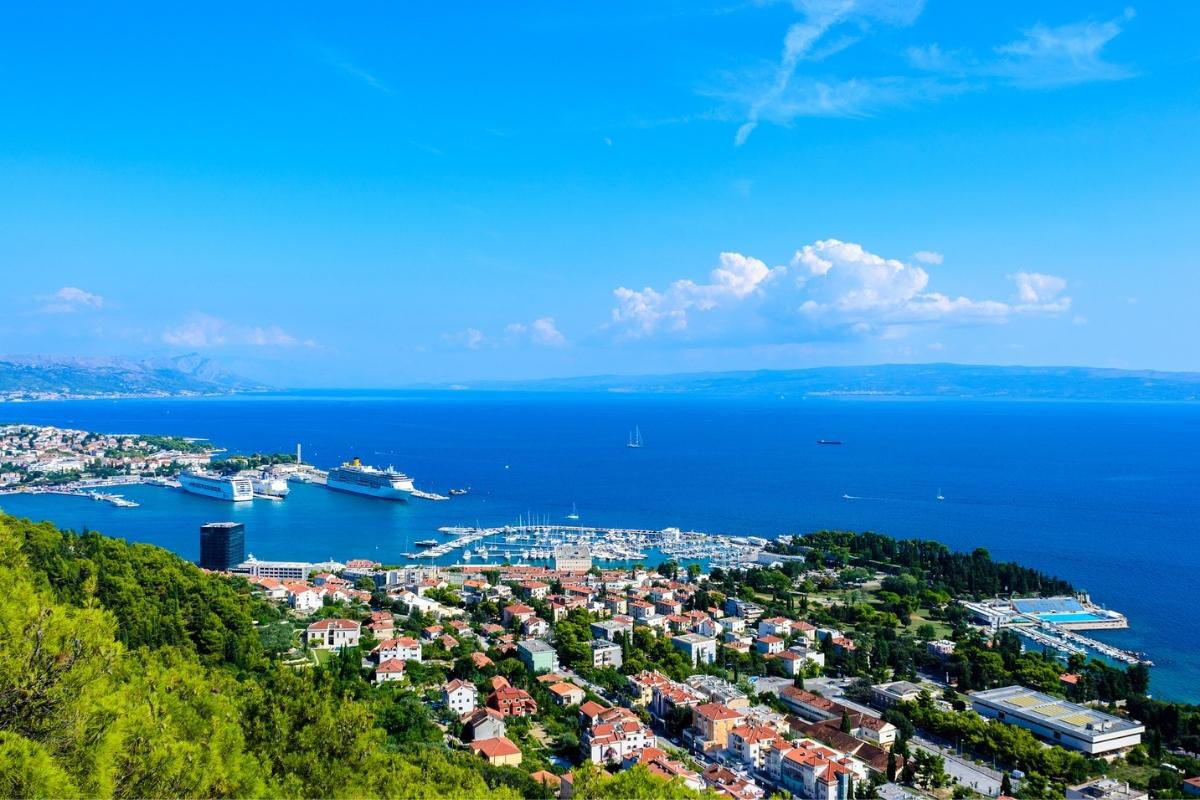
Nestled along the Adriatic Sea, Split is rich with captivating geological features and diverse minerals. The Dinaric Alps, which stretch through Croatia, are a treasure trove of karst landscape.
What’s karst? It’s a type of terrain formed by the dissolution of soluble rocks, including limestone and dolomite. The Dinaric Alps showcase remarkable karst features, including caves, sinkholes, and underground rivers. It’s a thrilling sight for any geology enthusiast!
Speaking of limestone, it’s everywhere in Split! The city’s historical center, Diocletian’s Palace, is made entirely from local white limestone, quarried from the nearby island of Brač. Walking through Split is like stepping into a geology lesson, with its stunning displays of limestone architecture.
If you’re more of a beach bum you can also take a look at our suggestions on coastal destinations in Croatia.
Not far from Split, you’ll discover Krka National Park. The park is home to a series of beautiful limestone waterfalls. These falls, created by deposited travertine (a form of limestone), are fantastic examples of how water interacts with rock over time.
Also, be sure to check out the Adriatic Sea’s coastline. Its beautiful pebble and sandy beaches are a mix of minerals and rocks carried by the River Cetina. As you wander along the shore, you can search for different rock types, each with its own tale to tell.
Finally, visit the local markets in Split. Vendors often sell beautiful Croatian rocks and minerals. You can find gorgeous specimens of red and pink coral, and with a keen eye, even blue Adriatic calcite!
Petrified Forest National Park – Arizona
This place is famous for its petrified wood, which are actually ancient trees turned into stone. Talk about a cool transformation!
The process of petrification started over 200 million years ago, when fallen trees got buried by sediment. Groundwater soaked with silica from volcanic ash seeped into the logs, and over time, the silica crystallized into quartz, turning the wood into stone. This process preserved even the smallest details of the tree, from the bark to the growth rings.
Now, these trees sparkle with colors from clear quartz to purple amethyst, yellow citrine, and smoky quartz. It’s like walking through a rainbow-colored stone forest!
And the best part? You can get up close and personal with these petrified logs along the park’s many trails.
But that’s not all. Petrified Forest is also home to the Painted Desert, a landscape of beautiful badlands. Erosion has carved into the layers of sediment, revealing a time capsule of the Earth’s past. The layers are different colors because of the minerals they contain, creating a vibrant, multi-colored landscape.
The Azores – Portugal
The Azores are an archipelago in Portugal with nine volcanic islands, situated in the middle of the Atlantic Ocean, are full of thrilling geological features to explore.
Let’s start with the volcanic activity. The Azores are a part of the Mid-Atlantic Ridge, a massive underwater mountain range. This range is a boundary between tectonic plates where new ocean floor is being created.
Pico Island, home to Portugal’s highest peak, Mount Pico, is a prime example. This stratovolcano is a rock-lover’s delight, and one of the best places for a wildlife holiday in Europe, featuring a variety of volcanic rocks like basalt, trachyte, and obsidian.
On the island of Terceira, you’ll find the Algar do Carvão, a unique volcanic chimney that you can actually walk inside! Its walls are adorned with shimmering silicates and vibrant green and yellow algae. You’ll also see stalactites and stalagmites formed by volcanic activity, not the typical limestone-based ones we often think of.
São Miguel Island is famous for its geothermal areas, like the Furnas Valley. Here, cooking holes use the earth’s natural heat to prepare a local stew called “Cozido das Furnas.” Not only can you enjoy a delicious meal, but you can learn about geothermal energy too!
Don’t miss the chance to see the island’s stunning crater lakes. These lakes, formed by volcanic activity, like the twin lakes of Sete Cidades, are famous for their different colors – one blue and one green. It’s a fantastic way to appreciate how geology affects our landscapes.
The Azores also have fantastic mineral displays. The island of Santa Maria, with its layered sedimentary cliffs, is rich in fossils and the perfect spot to see ancient oceanic sediments.
For rock and geology lovers, the Azores are a volcanic and mineral-rich paradise. Grab your hiking boots and rock hammer – it’s time to explore the geological wonders of the Azores!
Lassen Volcanic National Park – California
Lassen Volcanic National Park in California is a geology wonderland that has everything a rock and mineral enthusiast could dream of.
The star of the show is Lassen Peak, one of the largest plug dome volcanoes in the world. It last erupted in 1915, but don’t worry, it’s been quiet since then. It’s easily one of the must-visit wonders of California.
The peak is composed of dacite, a type of volcanic rock that’s rich in silica. This makes it more viscous, which is why it forms a dome instead of flowing out like lava.
And that’s not all! The park is also famous for its hydrothermal features, including mud pots, boiling pools, and steam vents. These are caused by water heated by magma beneath the earth’s surface. They’re like nature’s own chemistry lab, where minerals dissolve and crystallize in fascinating ways.
One of the coolest places to see these features is Bumpass Hell, the park’s largest hydrothermal area. Here, you can see pools of boiling water and mud pots that gurgle and pop.
The ground is colored by minerals like iron, which gives it a rusty red color, and sulfur, which paints it yellow. From the fiery peak of a volcano to the bubbling mud pots, Lassen Volcanic National Park is a must-visit destination.
Athens – Greece

This ancient city is situated in the Attica Basin, surrounded by mountains and lined by the Aegean Sea, offering a variety of fascinating geological features to explore. If this isn’t on your European bucket list it should be!
Start with the most famous landmark, the Acropolis. It’s made of limestone, a sedimentary rock formed from ancient sea life. This limestone dates back to the Jurassic period, over 140 million years ago. Imagine, walking on the same rock that dinosaurs might have seen!
The surrounding hills of Athens, including Mount Lycabettus, Mount Aigaleo, and Mount Hymettus, are mainly made of limestone and marble. These rocks tell the story of the city’s geological history, formed over millions of years.
Mount Parnitha, the highest mountain in Attica, is known for its marble and schist, a metamorphic rock. These rocks have withstood the pressures and temperatures deep within the Earth, transforming into something new and beautiful.
And did you know Athens is earthquake-prone due to the city’s location on the Eurasian and African Plate boundary? This tectonic activity has shaped the land over time, creating the mountain ranges and valleys that we see today.
Don’t miss a visit to the National Garden, where you can find an impressive collection of rocks and minerals from all over Greece. You can see different types of marble, limestone, and even some volcanic rocks.
Kyoto – Japan
The ancient city of Kyoto is nestled among mountains and valleys in the Tamba highlands. These highlands consist of old metamorphic rocks, such as gneiss and schist, which were formed deep within the earth under high temperature and pressure. These rocks provide a window into the deep geological past of the area.
If you haven’t been to Japan before be sure to check out our guide on what you need to know before visiting.
Next, let’s visit the nearby Higashiyama Mountain Range, made primarily of granite. Granite is an igneous rock formed from the slow cooling of magma.
Its sparkling minerals, including quartz and feldspar, make it a favorite among rock lovers. The granite from this range was used in many of Kyoto’s famous temples and shrines.
The Kamo River, which flows through Kyoto, is also an exciting spot. The river’s gravel and pebbles are composed of diverse rock types, carried from the surrounding mountains. As you stroll along the riverbanks, you can spot basalt, chert, and quartz among others.
Kyoto also features beautiful zen gardens like Ryoanji Temple’s dry landscape garden. The carefully arranged rocks and raked gravel serve as a symbol of nature, but also provide a wonderful chance to appreciate the beauty of rocks.
Banff National Park – Canada

This park within the Canadian Rockies is packed full of geological wonders that will thrill any rock lover.
Let’s begin with the mountains themselves. They’re primarily made of sedimentary rock, including shale, limestone, and sandstone, formed over 500 million years ago at the bottom of a massive sea. These rocks were later pushed upwards during the formation of the Rocky Mountains.
Mount Rundle is a must-see. This towering peak showcases an excellent example of a thrust fault, where older rocks are pushed above younger ones. Fascinating, right?
If you’ve read our list of things to do in Banff during the summer a lot of this is probably looking pretty familiar!
Next, visit the Burgess Shale, one of the world’s most important fossil sites. Here, you’ll find fossils over 500 million years old! These well-preserved specimens give us unique insights into early life on Earth.
You’ll also find stunning glacial features in Banff. Glaciers have shaped this landscape over thousands of years, carving out valleys and depositing rocks and sediment. The U-shaped valleys, moraines, and hanging valleys are fantastic examples of glacial geology.
Don’t miss the unique hot springs in Banff. These geothermal features are formed by rainwater that seeps deep into the earth, heats up, and resurfaces. The minerals dissolved in this water are what create the beautiful colors often seen in hot springs.
Finally, explore the park’s numerous caves, many formed within the soluble limestone rocks. Rat’s Nest Cave, with its intriguing stalactites, stalagmites, and fossils, is particularly amazing.
Aoraki/Mount Cook National Park – New Zealand
Mount Cook National Park in New Zealand offers an outstanding variety of geological wonders.
Let’s start with the centerpiece, Aoraki/Mount Cook, the tallest mountain in New Zealand.
It’s made up mostly of greywacke, a type of hard, dark sandstone. This rock was formed millions of years ago, deep under an ancient sea, before tectonic forces pushed it upwards to form the mountain we see today.
Glaciers are a big part of the park’s landscape. These slow-moving rivers of ice have carved the land over thousands of years, creating striking features like U-shaped valleys and cirques. You can witness the power of glaciers at the Tasman Glacier, the longest glacier in New Zealand.
The park is also home to fascinating glacial lakes, like Lake Pukaki and Lake Tekapo. These lakes have a stunning turquoise color, thanks to the “rock flour” – finely ground rock particles created by the moving glacier – that flows into the lakes from melting glaciers.
Don’t forget to look for schist, a type of metamorphic rock that can be found in this region. Formed under high pressure and temperature, schist often contains shiny minerals that sparkle in the sunlight.
Finally, the park’s Hooker Valley Track offers an up-close look at the park’s geological features. Along this track, you’ll see moraines, which are mounds of rock and debris left behind by receding glaciers.