


Namibia is a stark and stunning country, located on the southwestern coast of the great African continent. It’s the newest country with the oldest desert, and it’s home to several intriguing Namibian tribes.
Each of these tribes has their own unique and fascinating customs and traditions. Namibia is a mosaic of cultures that have evolved over thousands of years. They range from the Himba people of the north-western Kunene Region to the Damara of the central regions to the Nama of Namaqualand in the south.
All of these cultures are an important part of Namibia, and they play an important role in the country’s history and heritage. Many of the Namibian tribes have managed to maintain their traditions and customs despite the pressures of modernization and globalization. And these pressures can be great.
This makes Namibia a compelling destination for those who enjoy experiencing different cultures. The tribes of Namibia can seem like a complex subject, though.
Their origins reach far back into history, and the threads of their journeys to Namibia tangle more often than not. As well, most tribes are known by more than one name, and can seem confusing. As you read on you’ll see that this is just another fascinating aspect of these tribes.
Namibian Tribes
Africa is a tribal continent, and over 3000 different tribes can be found scattered throughout its 54 countries. Several of those can be found in Namibia.
Below you’ll get a glimpse of these amazing people, starting with the largest of the tribes – the Ovambo.
The Ovambo Tribe
The Ovambo people, also known as the Aawambo or Ambo, are the largest ethnic group in Namibia. They currently account for about half of the country’s entire population, or approximately 1.3 million people. The tribe also exists in southern Angola, where there are estimated to be around 700,000 Ovambo people.
Their origins can be traced back 2000 years, to the migrations of the indigenous Bantu group from west-central Africa. A large portion of this group decided to settle in the northern regions of Namibia and southern Angola. They established a strong agricultural society here around the 14th century.
This group came to be known as the Ovambo people.
Today they’re known for their rich and independent culture, built on traditional music, dance, and dress. They can be recognized by their traditional clothing, which tends to be full of colour.
A customary outfit for a woman consists of a skirt or dress, long and full, with equally full, puffed sleeves. Pink is worn often, and the clothes are made from a fabric called odelela.
Women will add leather, beads, and seashells, depending on the occasion, as well as age and marital status. Men’s clothing might be a bit more subdued in colour, but is still made from the unique odelela fabric.
The Ovambo are also known for their ancestral architecture. Many of these tribespeople still living in the northern villages have homes made with mud and thatch. They’re built in the rondavel style, with round walls and a conical grass roof.
Many villages, though, now have one or two brick or concrete block homes. As well, some Ovambo have left their villages for the towns and cities of Namibia. However, the tribe is still a distinct group, proud of their heritage, and in no hurry to let go of the old ways.
The Ovambo people play a significant role in Namibian life, with many of them being involved in politics, business, and agriculture. They are known for their entrepreneurial spirit, and many Ovambo own successful businesses in the country.
Though they separated so many years ago, the Ovambo people still have close ties to other Bantu tribes in southern Africa, such as the Herero and the Xhosa. They also have cultural similarities with the Zulu people of South Africa.
The Herero People

The Herero people are a proud and resilient Namibian tribe. This ethnic group originated in the central and eastern regions of Africa. They are another of the largest ethnic groups in Namibia, where they have played a significant role in the country’s history and culture.
The Herero are believed to have migrated to Namibia from the Great Lakes region of East Africa several centuries ago. They were traditionally pastoralists, raising cattle and other livestock, and were known for their distinctive clothing and jewelry.
Today, the Herero people are an integral part of Namibian society. They are known for their dynamic culture, including their traditions of music and dance. They are likely one of the most visibly recognizable groups, owing to their unique attire.
The Herero dress originated with the German wives of colonialists and missionaries. These wives predictably objected to the minimal dress of Herero women, who were made to wear the ‘Ohorokova’ after Germany colonized the area.
Consisting of a many-petticoated A-line skirted dress in colourful fabric, the Ohorokova is accompanied by a hat in matching fabric. The hat actually celebrates the Herero history as cattle breeders with a horn-shape built onto either side.
The ensemble, worn now as everyday dress only by older or married women, is a form of protest by the Herero. It’s worn in memory of Germany’s attempted genocide of the Herero people between 1904 and 1908. Thousands died under German colonial rule during this time.
The Herero tribespeople are now distinguished for their resilience and perseverance in the face of adversity. Because despite this adversity, they’ve managed to preserve their culture and traditions and continue to thrive in Namibia today.
In fact, according to the latest census data there are approximately 240,000 Herero people currently living in Namibia. Despite the challenges they’ve faced over the years, they remain a proud and irrepressible part of Namibia’s cultural heritage.
While the majority of Herero people live in Namibia, they are also well represented in Botswana and Angola.
The Himba People

The Himba people are one of the most prominent tribes in Namibia. They are known for their striking appearance and distinctive red ochre body paint. They live in the rugged and beautiful landscapes of the remote north-western Kunene Region.
Here many have managed to preserve their traditional way of life. They have a strong connection to the land and the natural world, and their culture is deeply rooted in their environment.
The Himba are semi-nomadic pastoralists who rely on their herds of cattle, goats, and sheep for survival. They move their animals to different grazing areas depending on the season.
They are also skilled farmers, growing crops like millet and squash in the fertile areas along the Kunene River. The Himba diet consists mainly of milk, maize, and sorghum.
Many still live in small communities of extended families.
As mentioned, the Himba people are known for their distinctive appearance. The women cover their bodies in a mixture of red ochre, butterfat, and herbs. This gives their skin a rich, reddish-brown color and protects them from the harsh desert sun.
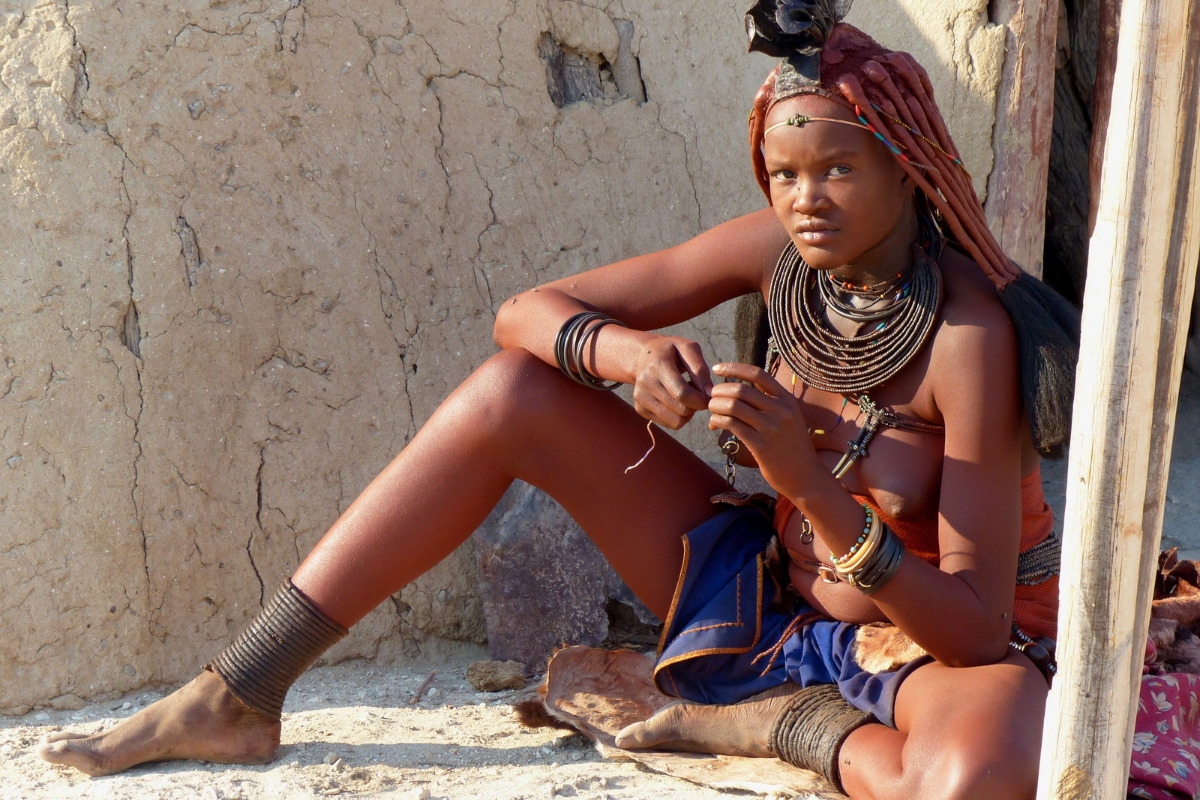
They also have intricate hairstyles, with braids often packed with the same ochre mixture. They also wear tribal jewelry made from iron and shell beads.
Traditionally, the tribe practices polygamy within a matriarchal society. Women play a significant role in decision-making processes.
The Himba people are believed to have originated from the Herero tribe of Angola, who migrated to northern Namibia in the 16th century. They’re closely related to the Damara and San tribes of Namibia, as well.
They share many cultural traditions and beliefs with these other groups. But over time, the Himba developed their own unique culture, customs, language, and traditions that set them apart from other tribes in the region.
It’s these that make them a distinct and fascinating people.
However, despite their unique culture, today’s Himba people face numerous challenges. The modern world is encroaching on their traditional lands, and drought and disease threaten their way of life. There are currently estimated to be around only 50,000 Himba people in Namibia, and their numbers are declining.
Many Himba people in today’s world have become involved in Namibia’s ecotourism industry. They proudly share their unique culture and way of life with visitors from around the world. One way they do this is through their skills in crafting and jewelry making. Their work is highly sought after by tourists, and their products are sold in local markets.
This presents a paradox. Though these ecotourism efforts celebrate the Himba’s way of life, there are concerns that increased tourism could further erode that very way of life.
The Ovatue People
The Ovatue tribe is also believed to have originated from the Herero people, and are closely related to other Bantu tribes in Southern Africa.
Today, many Ovatue people live in rural areas and practice their ancestral ways of agriculture and animal husbandry. They are known for their skill in weaving, pottery, and basket-making, and their crafts are highly sought after by tourists and collectors.
One outstanding quality of the Ovatue people is their close relationship with nature. They believe that all living things are connected, and that humans have a responsibility to live in harmony with the environment. They also place a strong emphasis on community and family, and practice a form of communal land ownership.
While the Ovatue people are primarily concentrated in Namibia, there are also smaller communities of Ovatue people in neighboring Angola and Botswana.
As of 2021, it is estimated that there are around 30,000 Ovatue people living in Namibia. While their numbers have been relatively stable in recent years, they, like many indigenous communities in Namibia, and around the world, face ongoing challenges related to land rights, cultural preservation, and economic development.
The Damara People
Another important tribe in Namibia, the Damara people are also known as the Bergdama or ǂKhumbi. They’re believed to have migrated to Namibia from Angola around 500 years ago. While the majority of Damara now live in Namibia, there are also smaller numbers in Botswana and South Africa.
The Damara tribespeople are known for their unique “click” language, and for cultural practices such as their hunting rituals. Damara are found mainly in small towns in the central parts of the country, such as the Erongo Region. Many now live in Namibia’s capital city of Windhoek, as well.
The Damara are skilled artisans and craftsmen, recognized for their intricate beadwork, pottery, and carvings. They’re also known for their distinctive vocal harmonies and rhythmic dances.
As well, they have a strong spiritual connection to their ancestors, and they believe strongly in the power of nature.
Many Damara continue to practice their traditional semi-nomadic way of life today, communing with nature as their ancestors did. This involves cattle herding, hunting, and gathering, as well as some agriculture.
The Damara people make up around 7% of Namibia’s population, with an estimated 108,000 Damara living in Namibia today. This number makes them one of the smaller ethnic groups in the country. Despite this, they continue to maintain many aspects of their unique traditions and cultural identity.
But, like other Namibian tribes, they’ve faced many challenges over the years. These include displacement from their ancestral lands, as well as marginalization by other ethnic groups.
Like the Himba and others, the Damara people are closely related to the Herero tribe. They also have some genetic and cultural ties to the San people, who are indigenous to southern Africa.
The San People

The San people, also known as Ju/’Hoansi, or pejoratively as Bushmen, are one of the oldest tribes in Africa. They are the earliest known inhabitants of what is now known as Namibia.
The San origins can actually be traced back over 20,000 years, making them one of the most ancient societies on earth. They are known for their ingrained way of life, which is based on hunting and gathering.
The San people are believed to have originated in East Africa, migrating southwards over thousands of years. Evidence suggests that they were forced to migrate due to the changing climate and competition for resources.
As they moved southwards, these hunter-gatherers encountered new environments and adapted their lifestyles to survive in them. They likely settled in Namibia for its abundant wildlife and resources.
The San people live in harmony with nature, and they’ve developed a deep understanding of the environment around them. They are known for their hunting skills, and for their use of plants for medicinal and spiritual purposes.

The San people play an important role in the cultural heritage of Namibia. They are known for their intricate and beautiful rock art, which can be found throughout the country. They also have an extensive knowledge of the local flora and fauna, and their traditional medicines are still used by tribespeople today.
The San have a complex relationship with other African tribes. They have been historically marginalized and discriminated against, but efforts are being made to safeguard their culture and way of life.
While the San people are primarily a Namibian tribe, they can also be found in other African countries. These include Botswana, Angola, and South Africa.
Today, it is estimated that there are around 27,000 San people living in Namibia. Their numbers, like those other Namibian tribes, have been in decline. However, efforts are being made to support their communities and preserve the old ways for future generations.
Many San today live on the Nyae Nyae Conservancy near the northern Namibia/ Botswana border. Visitors here can observe tribespeople going about traditional tasks, and have the opportunity to buy jewelry and crafts made by San women.
The Nama People
The Nama people are another one of Namibia’s indigenous tribes, with a history that dates back thousands of years. Originally from the northern regions of South Africa, the Nama migrated to Namibia in the 18th century and have since become an indispensable part of the country’s cultural tapestry.
Today this tribe is concentrated in the central part of the country, though minor groups have settled in Namaqualand, of flower fame, on the South African border. There are also smaller populations of Nama in South Africa and Botswana.
There currently appear to be some 200,000 Nama people living in Namibia, with the majority residing in rural areas. They have traditionally lived a semi-nomadic lifestyle, which centers around herding livestock and subsistence farming.
Like the Damara, the Nama are also renowned for their unique language, characterized by a clicking sound that is made by the tongue. They are known, too, for their exquisite beadwork, which is often used to decorate clothing and jewelry. They create musical instruments, as well, and their leatherwork and clay pots display excellent craftsmanship.
Additionally, the Nama people are famous for their oral traditions, including storytelling and music. In fact, UNESCO has added the Nama’s music and dance to their “List of Intangible Cultural Heritage in Need of Urgent Safeguarding”.
This action was prompted by the alarming fact that only a few elders of the Nama communities are still familiar with the ancestral musical traditions. Younger generations gravitate more to modern instruments and away from the ancient ones. Fortunately, the traditional dance known as the “Nama stap” is still widely known.
The Nama people are part of the Khoisan ethnic group, which includes a number of other tribes in southern Africa. They have historically had close ties to the San people, with whom they share many cultural similarities. Another tangle in the thread of Namibian tribes.
The Caprivian People
The Caprivian people are also known as the Mafwe. They are an ethnic group that hails from the Caprivi Strip, the narrow stretch of land in northeastern Namibia that borders Angola, Botswana, Zambia, and Zimbabwe. Historically, the Caprivians have been a fiercely independent people who have resisted colonization and assimilation.
Today, the Caprivians are another vivid part of Namibia’s fascinating cultural tapestry. They are known for their vibrant music and dance, as well as their skill in crafts such as basket weaving and pottery. The Caprivians have a reputation for being proud and dignified, with a strong sense of community and respect for tradition.
The origins of the Caprivian people are not entirely clear, but it is believed that they migrated to the Caprivi Strip from Central Africa several hundred years ago. They have close cultural and linguistic ties to other Bantu-speaking tribes in the region.
Despite these connections, the Caprivians have maintained a distinct identity, with their own language, customs, and social organization. They have also had to contend with conflict and displacement over the years. These have included clashes with neighbouring tribes and the effects of colonialism and apartheid in Namibia.
Today, there are an estimated 120,000 Caprivian people in Namibia, making up around 5% of the country’s population. They are concentrated in the Caprivi Strip and surrounding areas, but can also be found in other parts of Namibia and neighboring countries such as Angola and Botswana.
Despite the challenges they’ve faced, the Caprivians continue to celebrate and preserve their culture. They have a deep connection to the natural world, with many of their songs and stories centered around the animals and landscapes of their land.
The Caprivian people are a testament to the resilience and diversity of Namibia’s cultural heritage. Their traditions and way of life are a distinct part of the country’s identity, and a source of inspiration for all who seek to honor the past while looking towards the future.
Conclusion – The Tribes of Namibia
Visiting Namibia allows you to experience not only the breathtaking landscapes and epic wildlife. It also provides you with an opportunity to experience the unique cultures and traditions of its indigenous tribes. It’s these tribes that have created the enigmatic country that is Namibia.
From the Himba to the San, each tribe has its own distinct way of life that has withstood the generations. It’s important to explore these cultures before the tribes’ ancestral ways are lost in time. By visiting and learning about these communities, we can gain a deeper understanding and appreciation of their way of life. And maybe of our own.


