

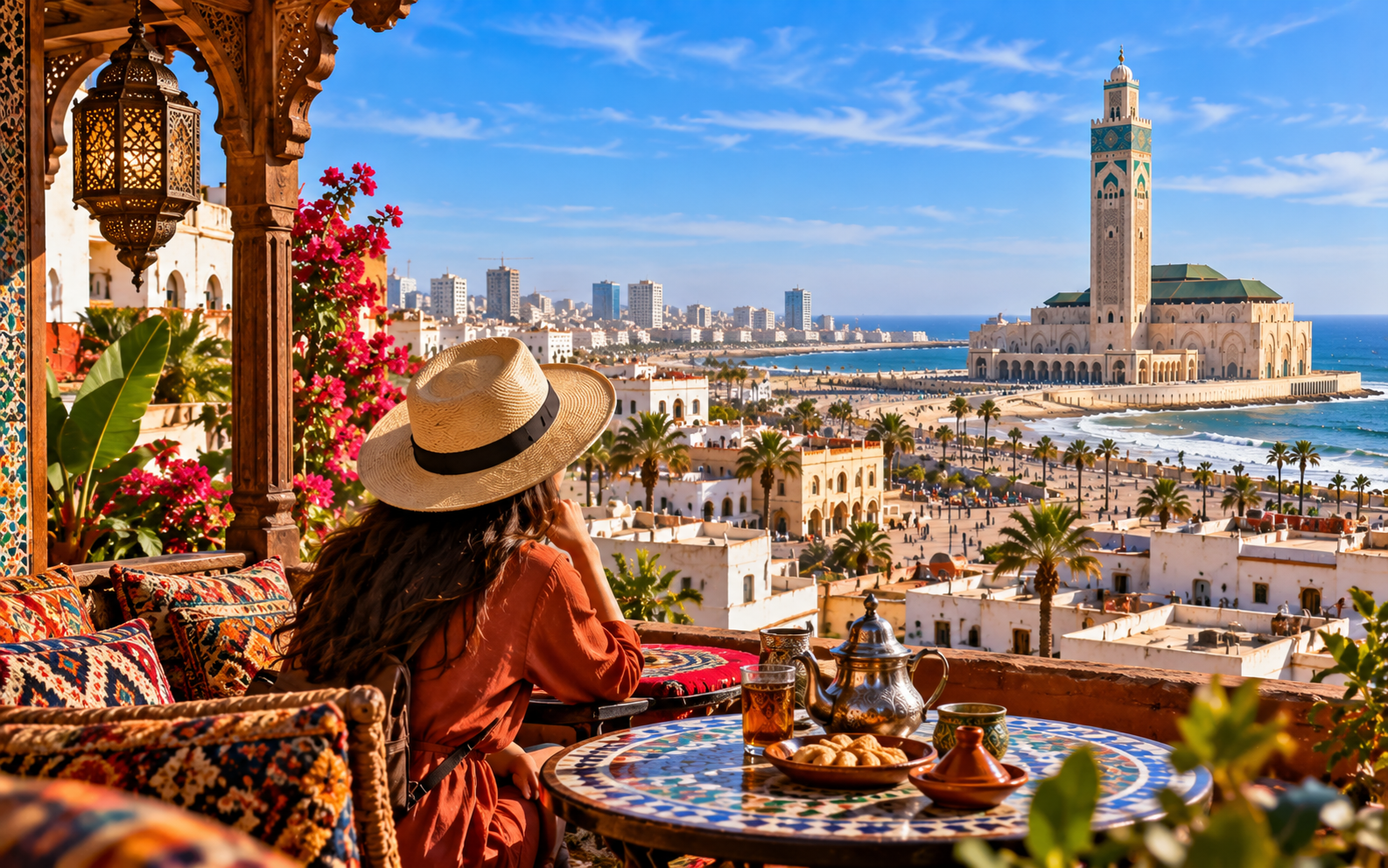
Everyone falls for Marrakech the same way. The first evening on Jemaa el-Fnaa as the food stalls light up and the drummers start, the first morning lost in the souks, the first mint tea on a riad rooftop with the Koutoubia minaret glowing pink against the Atlas. The city is intoxicating, and it is designed to keep you inside its walls. But here is the thing seasoned Morocco travellers eventually learn: Marrakech is not just a destination, it is a base camp, and some of the most unforgettable places in the country sit one to three hours from the medina gates, in directions no tour bus schedule does justice to.
The snow-dusted High Atlas, the Agafay desert’s lunar camps, the blue fishing port of Essaouira, the film-set kasbah of Ait Ben Haddou, each of them is a day trip or an overnight from the Red City, and the difference between experiencing them on your own clock versus a group itinerary is enormous. That is where a Marrakech car rental changes the shape of the whole trip. Economy cars start from roughly 200 to 350 dirhams a day, around 20 to 35 US dollars, pickup works from Menara airport, the train station, or your riad’s nearest gate, and suddenly the sunrise departure, the extra hour at the waterfall, and the spontaneous detour through a Berber village all belong to you.
We have put together this guide the way we wish someone had for us: which drives are worth it, what driving in Morocco is actually like, and the booking details that save first-timers the common headaches.
The Day Trips That Make the Rental Worth It
Start with the Atlas, because it is closer than it looks from your rooftop. The Ourika Valley is barely an hour south, a green ribbon of walnut groves, riverside tagine restaurants, and the waterfall hike at Setti Fatma, perfect as a first outing and a world away from the medina’s intensity. Push a little further and the Oukaimeden road climbs to ski-resort altitude with views that do not seem possible this close to a desert city. In the other direction, the Agafay desert, forty minutes out, delivers the dunes-and-camps experience without the eight-hour Sahara drive, and sunset dinner at an Agafay camp with the Atlas silhouetted behind is one of Morocco’s great easy wins.
The two bigger adventures deserve full days or overnights. Essaouira, about two and a half to three hours west on an easy road, swaps Marrakech’s red walls for Atlantic blue, a laid-back fortified port of seafood grills, gnawa music, and wind-whipped ramparts, and arriving with your own car means leaving before the heat and staying past the tour-bus departure hour. The other direction crosses the Tizi n’Tichka pass, one of North Africa’s great mountain roads, switchbacking over the High Atlas to Ait Ben Haddou, the mud-brick kasbah you have seen in a dozen films, roughly four hours each way and worth every bend; ambitious travellers continue into the Ouarzazate film country and make it a two-day loop. Add the Ouzoud waterfalls, two and a half hours northeast with their resident monkeys and rainbow spray, and you have a week of world-class excursions radiating from one base.
Within the city itself, be honest about what the car is for: nothing. The medina is gloriously car-free, your riad is reached on foot through the lanes, and the Majorelle Garden and Gueliz are short taxi hops. The rental earns its keep entirely beyond the walls, so many travellers collect the car on day three, after the city days, which also trims the bill.
What Driving in Morocco Is Really Like
Easier than its reputation, is the short answer, with a few local customs worth knowing. The roads on every route above are paved and well maintained, the autoroute toward Casablanca is smooth and modestly tolled, and the mountain roads are engineered properly, just respect the bends and share them patiently with trucks. Moroccan city traffic is assertive but readable; drive calmly and predictably, treat roundabouts as exercises in eye contact, and you will have the rhythm within an hour. Police checkpoints on intercity roads are routine and nothing to fear, a polite bonjour with documents ready is the entire transaction, and the radar culture means the posted speed limits are the actual speed limits.
Parking runs on a charming informal economy: outside the medina gates and at every attraction, vested guardians will wave you into a spot, watch the car, and see you out for a few dirhams, so keep coins handy and enjoy one of travel’s better bargains. Fuel stations are frequent and full service. Two honest rules round it out: avoid unfamiliar rural roads after dark, when unlit bikes and wandering livestock appear, and never attempt to drive into the medina itself, which is not a rule so much as a law of physics.
One practical note matters more in Morocco than almost anywhere: manual gearboxes are the national default. Automatics exist but in limited numbers at a premium, so if you need one, say so at booking rather than hoping at the counter, because the automatic fleet sells out first in every busy season.
Booking It Right: The Details That Matter
The paperwork is refreshingly light. You will need your home-country driving licence held for at least a year, an International Driving Permit is recommended and occasionally asked for, your passport, and a card for the deposit, with minimum ages generally starting at 21. The terms to confirm in writing before you commit are the insurance excess, the amount you would owe in case of damage, the mileage allowance matched against your day-trip ambitions, and the fuel and deposit policies. At pickup, do the two-minute ritual that protects every rental anywhere: walk the car slowly, film the existing scratches, check the spare wheel and warning triangle, and keep the video until you have handed the keys back.
For the booking itself, the approach we recommend for Morocco is comparing suppliers before you fly rather than negotiating at an airport counter, and OneClickDrive makes that unusually painless for this country: verified local suppliers across Marrakech and the other major cities on one screen with real photos and transparent dirham pricing, an assisted booking model where the team confirms the exact car, gearbox, and pickup timing for your dates, a small advance of around ten percent to secure it, and the balance paid directly to the supplier when the keys are handed over at the airport or your hotel. For first-time Morocco drivers nervous about the automatic shortage or arrival logistics, having those details locked before boarding is exactly the reassurance the counter queue never provides. One-way rentals, collecting in Marrakech and dropping in Casablanca or Agadir, are available too, which opens up the classic southern Morocco road trip without backtracking.
The bigger point is the one we keep relearning across every country we drive: the car is never really about the car. It is about leaving for the Tizi n’Tichka at dawn with the pass to yourselves, about the unplanned stop at a roadside pottery village that becomes the trip’s favourite hour, about reaching Essaouira’s ramparts while the tour groups are still boarding their buses in Gueliz. Marrakech will always be the headline, and it deserves its three days of souks and rooftops. But southern Morocco’s real magic lives down the roads that fan out from it, and for the price of a nice dinner per day, those roads are yours.


