


Vienna is the capital of Austria, the birthplace of classical music, and home to the Habsburg dynasty and its rich cultural heritage. The city center is sprinkled with green parks, pedestrian-friendly, and lined with quaint coffee shops. This itinerary for 3 days in Vienna takes you to highlights of this exquisite city, covering history, music, art, and of course, food!
The Habsburgs ruled Vienna for more than 600 years, so you’ll find a city full of grand boulevards and massive palaces. The city center is a UNESCO World Heritage Site that preserves much of the Hapsburg history. Mixed among these, you’ll find world-class museums and historic cafes serving exquisite pastries and confections.
A Quick History of Vienna

The history of Vienna is deeply tied to the history of the Habsburg family. This family ruled Austria (and, at times, Bohemia and even Spain) from 1282 until 1918. Emperor Franz and his wife Elizabeth (Sisi) are the most revered and famous of this large royal family.
In 1679 the bubonic plague killed almost 1/3 of the city’s population. During this time of upheaval, the city resisted several Ottoman attacks. In the 1700s, many of the city’s baroque palaces and mansions were built. Mozart gave his first concert in Vienna in 1762 at the age of seven. By the 1780s, the golden age of classical music was well underway, with both Haydn and Mozart performing in Vienna.
Napoleon occupied Vienna twice in 1805 and 1809. After the 1848 revolution, Franz Joseph was named Emperor.
In 1867 Vienna became the capital of the Austro-Hungarian Empire. This was in no small part due to the charms of Empress Sisi, one of Vienna’s most famous residents (ok, well, next to Mozart), who spoke fluent Hungarian and was beloved by the Hungarian people.
WWI was the end of the Austrian empire- in 1919, the Republic of Austria was formed. In 1938 Austria was annexed by Germany (Anschluss). After heaving bombing during WWII, Vienna was liberated in 1945 by Soviet troops. It was then divided into occupation zones controlled by the Allied powers. Austria did not gain independence again until 1955. You can visit the room in the Belvedere where this independence was granted with the signing of the Austrian State Treaty.
How to Spend 3 Days in Vienna
There are so many things to do in Vienna, from historical coffee shops to endless museums, you can’t possibly do it all in 3 days! Here is a 3-day itinerary for Vienna that pulls together a mix of history, culture, music, and sightseeing so you can see the highlights in just a few days.
As you move about Vienna, use the same precautions as you would in any major city. However, you should know that Vienna is a very safe city. It consistently ranks as one of the safest cities in Europe. Residents routinely report taking public transportation late at night without any safety concerns.
Day 1: Historic Central Vienna
On your first day in Vienna, spend your time soaking in the historic center with its wide boulevards and the expansive Hofburg Wein Palace complex. This palace complex was the winter palace and the main seat of the Habsburg dynasty and remains the office of the Austrian President. The seat of government since 1279, this complex was expanded many times and has now been divided into many different museums, apartments, and offices.
Rathausplatz
Start your day at the Rathausplatz. “Rathaus” means town hall- this impressive neo-gothic building overlooks a plaza that holds many events, from a Christmas market and skating rink to a cinema in the summer months. There are free guided tours of the interior at 1 pm on Mondays, Wednesdays, and Fridays.
Stroll through the Rathauspark and into the neighboring Volksgarden. This is one of Vienna’s many public green spaces that are manicured and filled with delightful fountains and gardens. Pass the statue of Prince Eugene and into the Hofburg Wein.
Spanish Riding School

Called the Spanische Hofreitschule, the Spanish Riding School has been training horses and riders in their unique style for 450 years. Here, you can see the famous Lipizzaner horses- white stallions bred for their naturally balletic movements, perform their unique maneuvers. Watch the “ballet of the white stallions” in the Winter Riding School, a gorgeous baroque hall with chandeliers hanging above the sod floor.
The Spanish Riding School is UNESCO protected as “intangible cultural heritage of humanity”.
Full performances take place in the evenings but can be quite expensive. However, for a more affordable price, watch a training session each day at 10 am. This includes some younger horses (still grey) and older horses farther along in their years-long training. Tickets sell out quickly, so book in advance.
The main entrance to the Spanish Riding School is across the rotunda from the Sisi Museum. From the rotunda, exit with the Spanish Riding School on your right, and then head right down Reitschulgasse. You’ll be able to peer into the stables of the Riding School. You can book a separate tour to visit the stables and greet some of the horses if you wish.
Sisi Museum

Since you are right there, check out the Sisi Museum! This museum is dedicated to the famous Empress Elisabeth, also called Sisi. This museum also contains the museum of tableware and silver (silberkammer) and the Kaiser’s apartments. You’ll get an audio guide with your entrance fee that covers all of these. The path through the museum is one-way, though you can see more or less of the silver and porcelain by choosing your route.
You’ll end with the Sisi portion of the museum. Here you’ll learn about the empress who prided herself on her extremely slim waist and her long hair, which took hours to care for. You’ll see her apartments as well as some of her dresses. No photos are allowed in this part of the museum.
*Please note the Silver Collection will be closed from April 2023 until further notice.
Travel Tip: When you are ready for lunch, head to Wienerin, on Petersplatz 1. Along with highly rated Viennese specialties like goulash and spaetzle, they also have soups and risottos.
Imperial Treasury

One more stop in the massive Hofburg Wein! Take a stroll through the Imperial Treasury. You’ll see everything from a crib gifted to Napoleon to the crown of the Holy Roman Empire. Truly impressive stuff!
Cake at Demel

Now that you’ve filled yourself with the culture and history of Vienna take a well-earned break at Café Demel! This café has been serving delicacies since 1786. They are most famous for their kaiserschmarrn, but all of their cakes are delicious as well. Kaiserschmarrn is a sweet, fluffy pancake with raisins that is chopped into pieces and served with powdered sugar and a warm plum sauce. It is full of butter and sugar, and utterly delicious.
As you approach the café, you’ll often see two lines- one to get a seat inside and one to order a carton of Kaiserschmarrn “to-go.” You can also enter the Demel Shop without waiting in line, where you can buy slices of cakes to take away as well.
If this is your first time at Demel, we recommend queuing and sitting down for your first Kaiserschmarrn. While you wait to be seated, you can watch them making this treat in large pans behind the glass windows.
Travel Tip:The Kaiserschmarrn is best served (and eaten) warm, but many of the other café cakes can be taken with you to enjoy later. We recommend their Esterhazy torte and their chocolate truffle cake.
Explore Stephansplatz
Head to the Stephansplatz, the square surrounding St. Stephen’s Cathedral. You can go up in either of the bell towers of the church (one has an elevator, the other only stairs). The Stephansplatz is the heart of the pedestrian-only zone in the city center.
Wander along the Kärntner Strauss and Graben, taking in the shops, street food, and ambiance of these wide boulevards.
Day 2: Schönbrunn Palace
Schloss Schönbrunn was the summer palace of the Hapsburgs. This complex is on the western outskirts of Vienna, so you’ll want to take transport over to it (about 30-40 minutes from the center) and spend most of the day there.
Schönbrunn Palace is the most visited site in Vienna and a UNESCO World Cultural Heritage Site. It began as a hunting lodge and became one of the most important royal sites in Vienna.
There is so much to do at Schönbrunn. You can’t squeeze it all into one day. We recommend starting with the palace tour and the apple strudel presentation, then choosing one additional activity.
Tour Schönbrunn Palace

The rooms of Schönbrunn Palace are simply dazzling. You’ll find grand ceremonial spaces as well as more intimate personal apartments. There are several tours to choose from, each including more rooms than the next. All come with an included audio guide to lead you through the palace.
When in doubt, book the Imperial Tour- with an approximate touring time of 40 minutes. There are only so many sumptuous spaces you can absorb in one afternoon, and this will be quite enough for most visitors. You’ll visit 26 rooms, including Franz Joseph’s study and Empress Elizabeth’s study. You’ll also see where Mozart performed in the palace.
If you are an avid Habsburg fan and want to see as much as possible, you can choose the Grand Tour, which continues to an additional 13 rooms not seen on the Imperial Tour.
Apple Strudel Show

You won’t actually be making strudel, but you’ll be watching how it’s done, learning about the history of the dish, and, best of all, eating some! You’ll also leave with the recipe if you’d like to try to recreate this classic Austrian dish at home.
Travel Tip: Don’t skip this! It sounds touristy, but we attended with members of three generations, and everyone had a good time.
Children’s Museum
If you have children traveling with you, this is a must! The Children’s Museum is located in the wing of the palace where the actual young royals slept and played. You’ll find interactive exhibits from styling wigs to playing with old-fashioned dolls to elaborate dress up with sizes for kids and adults. There is also a dining room where adults can sit while the kids serve them fake food on silver platters.
Note: We were allowed two hours to spend in this museum, and had to come back a second time because the kids weren’t finished and loved it so much.
The Schönbrunn Zoo
Established in 1752, the Tiergarten Schönbrunn is the oldest zoo still in operation and a UNESCO World Heritage Site. After extensive renovations in 2012, the zoo is considered a top modern-era conservation zoo. You’ll find over 700 species of animals, from Giant Pandas to cheetahs, to penguins.
The Imperial Carriage Museum
This museum features royal carriages and riding gear from the Habsburgs as well as Napoleon. The ornate Baroque Imperial coach is the showstopper, but you’ll also learn about Viennese court life through paintings, riding accessories, and gowns.
The Gardens and Maze
Access to the gardens of Schönbrunn is free and open to the public, but you’ll need a ticket to access any of the more specific areas like the Maze, the Gloriette, the Privy Garden, or the Orangery Garden.
Gates open at 6:30 am.
Enjoy a Traditional Austrian Meal in a Tavern

After savoring apple strudel, have a light lunch so you have room for a hearty, traditional Austrian dinner at Reinthaler’s Beisl. Located at Dorotheergasse 2-4, you’ll find this unassuming tavern that serves delicious traditional food in a friendly, down-to-earth environment. Take your time with your meal, as you’ll only be a 3-minute walk from your next destination- St. Peter’s Church.
Attend a Concert
End your second day with a classical music concert. Vienna is world-renowned for its music and offers many venues, from traditional to more contemporary. We recommend a classical ensemble at St. Peters Church. The venue is small and intimate, and the acoustics are wonderful. You won’t be disappointed! Of course, make sure to book tickets in advance.
Day 3: Culture and Art
On your last day in Vienna, you’ll focus on culture and art- from the Opera House to one of Vienna’s many wonderful art museums.
Danube River Cruise
Spend your morning on a Danube River Cruise– seeing Vienna from a different perspective.
Starting at Reichsbrücke, enjoy a 2-hour cruise along the river, ending at Schwedenplatz. Sights along the way include the Danube Tower and the Millennium Tower. Your boat will pass through a lock system along the way.
Café Central
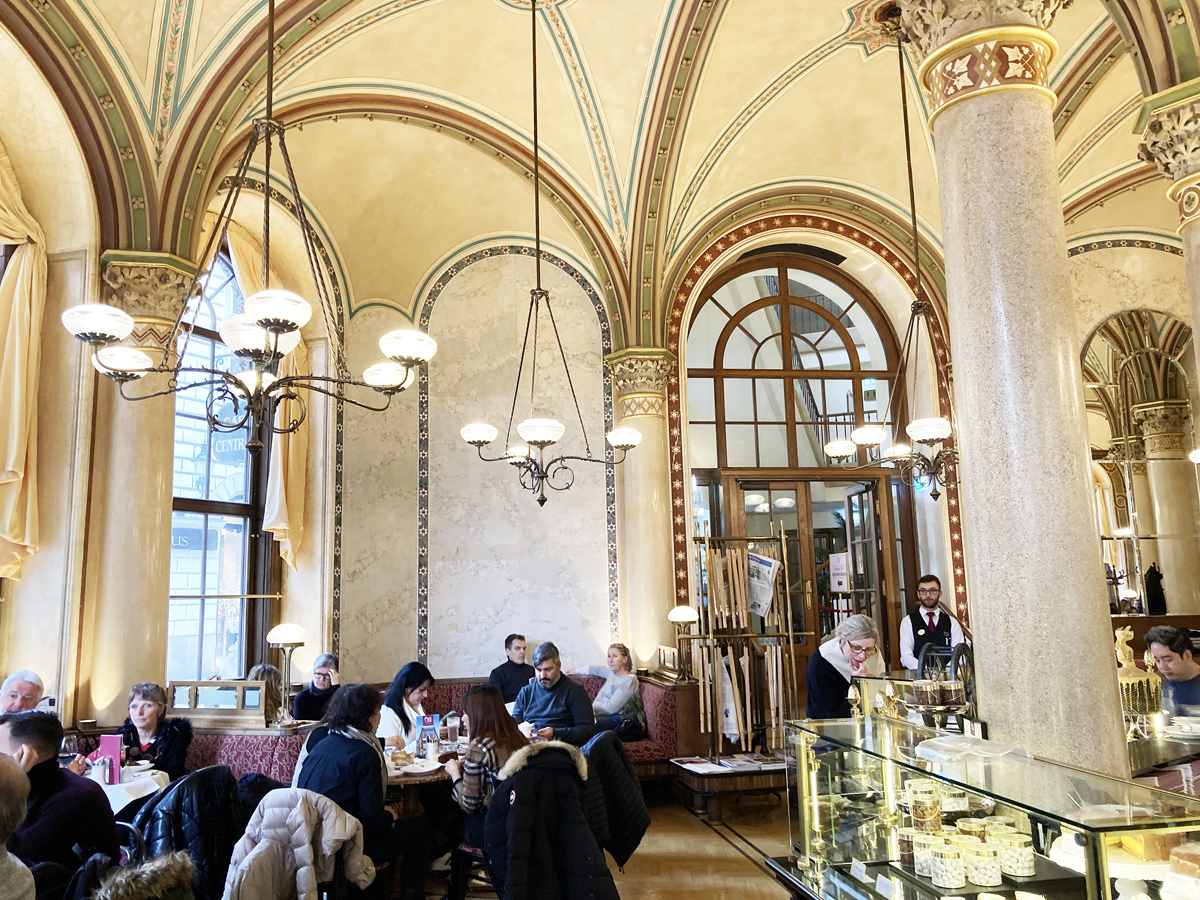
For lunch, head to Café Central. This coffeehouse is a Viennese institution. It’s been serving coffee and delicious cakes to poets and philosophers since 1876. Trotsky and Freud were both known to dine here.
You’ll find a selection of traditional Austrian dishes, including Klare Rindsuppe (beef soup with sliced pancake) and, of course Weiner Schnitzel. While the food is delicious, the show-stoppers are the desserts.
You’ll see glass cases filled with creations in various colors and flavors as you wait to be seated. They have Sisi’s Favorite- a rum pastry with apricot jam, as well as Coconut Breeze, a coconut cake with a mango passionfruit glaze. They also have standards like apple strudel and Kaiserschmarrn.
Travel Tip: We personally recommend trying the Weiner Krautfleckerl- square noodles with cabbage and cheese. They are absolutely delicious. Make sure to leave room for a dessert or two!
There is often a long line outside this café, so it’s best to make a reservation ahead of time. You can book online for groups of 6 or less, or call for larger groups.
Tour the Opera House

Opera is a big deal in Vienna- the Vienna State Opera House has performances 300 days a year, often a different production in the afternoon vs the evening. The Opera House also hosts the prestigious Vienna Opera Ball each year. Ready to learn more and see all the fancy rooms? Head to the Opera House for a 40-minute guided tour!
The whole family will love seeing the various elaborate rooms of the Opera House, and especially sitting in the royal box. Make sure to reserve tickets ahead of time, as they run tours in multiple languages and limit the size of each group.
See the Kiss at Belvedere

After learning about classical music at the Opera House, head south of the city center to Belvedere. The Belvedere Palace was once the summer residence of Prince Eugene of Savoy. It is now an art museum consisting of the Upper Belvedere (one of the world’s first public art museums) and the Lower Belvedere (Changing exhibitions) with gardens in-between, and the Belvedere 21 (Contemporary Art).
The main palace was damaged in WWII but reopened in 1953. Here, the Austrian State Treaty was signed, declaring Austria’s Independence in May 1955. When you visit the Upper Belvedere, you’ll see this room, as well as famous masterworks of art history, including several paintings by Gustav Klimt. The centerpiece here is “The Kiss”, but the other works in the museum are also worth viewing.
This is not a large museum, so plan to spend an hour or so on the art collection, then additional time exploring the gardens.
Alternate Destination: Prater Park
Not looking forward to spending time in an art museum? Have a beautiful day, and want to spend it outside? Head to Prater Park!
Originally built in 1897, the Prater boasted the largest Ferris wheel in the world for decades, right up until 1985. It was seriously damaged in World War 2, and today’s version is the rebuilt model from after the war.
Once an Imperial hunting ground, the Prater is free to wander through. The Prater is open 24 hours, all year round. While entering is free, each individual attraction has its own opening hours and fees.
How to Get Around Vienna

The city is set up with walking routes and lots of pedestrian-only walkways in the city center. You can walk to most places or take a tram, bus, or metro, all using interchangeable, flat-rate transit passes. All of this, plus the relatively flat terrain, makes getting around Vienna very easy.
You’ll also see lots of people biking around Vienna. There are bike lanes everywhere, and it’s very easy to rent a bike. Make sure to watch for cyclists when crossing the streets.
Consider a bike tour as a great way to see more of the city! (Bike Tour Link)
Where to Stay in Vienna
Vienna is separated into 21 districts, starting with District 1 in the city center and spiraling out toward the suburbs from there. You’ll want to stay close to the city center, so either in District 1, District 2, Leopoldstadt, which includes the Jewish Quarter, and Prater Park, or District 3, which includes the Belvedere.
Best Luxury Hotel: The Leo Grand

This five-star hotel is right in the center of Vienna, steps from St. Peters Church, and just one block from St. Stephens. In this amazing location, you’ll find a top-notch, unique hotel with exposed wood beams and thoughtful, creative décor. This boutique hotel is known for its high level of service in every way.
Best Midrange Hotel: Hotel Schani Salon

This four-star hotel is just a few blocks from the Leopold Museum, along Mariahilfer Straße, a popular shopping road. It’s located next to a metro stop and just a few stops from the Westbahnhof train station. Travelers love the comfy beds and the free coffee and fruit in the lobby.
When is the Best Time to Visit Vienna
The best time to visit Vienna is in the spring or fall when you’ll avoid the heat and the crowds of the summer.
During the Spring, the weather is pleasant, you can stroll through green parks, and the palace gardens will be in bloom. In March and April, Vienna hosts the Vienna Spring Festival, which features a series of classical music concerts. While March occasionally brings snow showers, by April, the weather has warmed, and you’ll find Easter markets to enjoy.
In the Fall, the temperatures drop, and leaves in the parks change colors. With a chance of rain, you’ll also find harvest festivals and the sampling of new wines. Expect to enjoy pumpkin, plum, and chestnuts during this season. If you visit during October, you might enjoy the Contemporary Music Festival, as well as Austria’s National Day celebrations on October 26th, marked by a large military parade.
An alternate time to visit Vienna is in December when you’ll be able to enjoy the famous Christmas markets (called Weihnachtsmärkts). The city is filled with Christmas cheer, and markets selling specialty foods, handicrafts, and of course, warm drinks pop up all over town.
Wiehnachtsmärkts usually opens in mid-November and stay open until Christmas Eve. A few will convert to New Year’s Eve markets and stay open a bit longer, but you’ll want to visit in December to take advantage of most of the markets.
FAQ: 3 Days in Vienna
Is 3 days enough in Vienna?
With 3 days in Vienna, you can see the historical and cultural highlights and get a feel for the city. We spent a month in Vienna and would still love to go back and explore more!
What is Vienna famous for?
Vienna is famous for its ornate palaces, classical music, and delicious pastries. As the seat of the Austro-Hungarian empire, it is a classically beautiful city, with tons of culture, from live concerts to art museums and galleries.
Do they speak English in Vienna?
Yes, most people in Vienna speak English, especially in touristy areas. While it is helpful to learn a few words in German before you arrive, you’ll have no trouble communicating using only English.
Final Thoughts: Vienna in 3 Days
With 3 days in Vienna, you’ll experience the royal history, grand boulevards, and rich culture this city is known for. From expansive palaces to delicious desserts, you’ll see the highlights of Vienna and be ready to plan your return trip! This is a city that is easy to walk around and easy to fall in love with!