

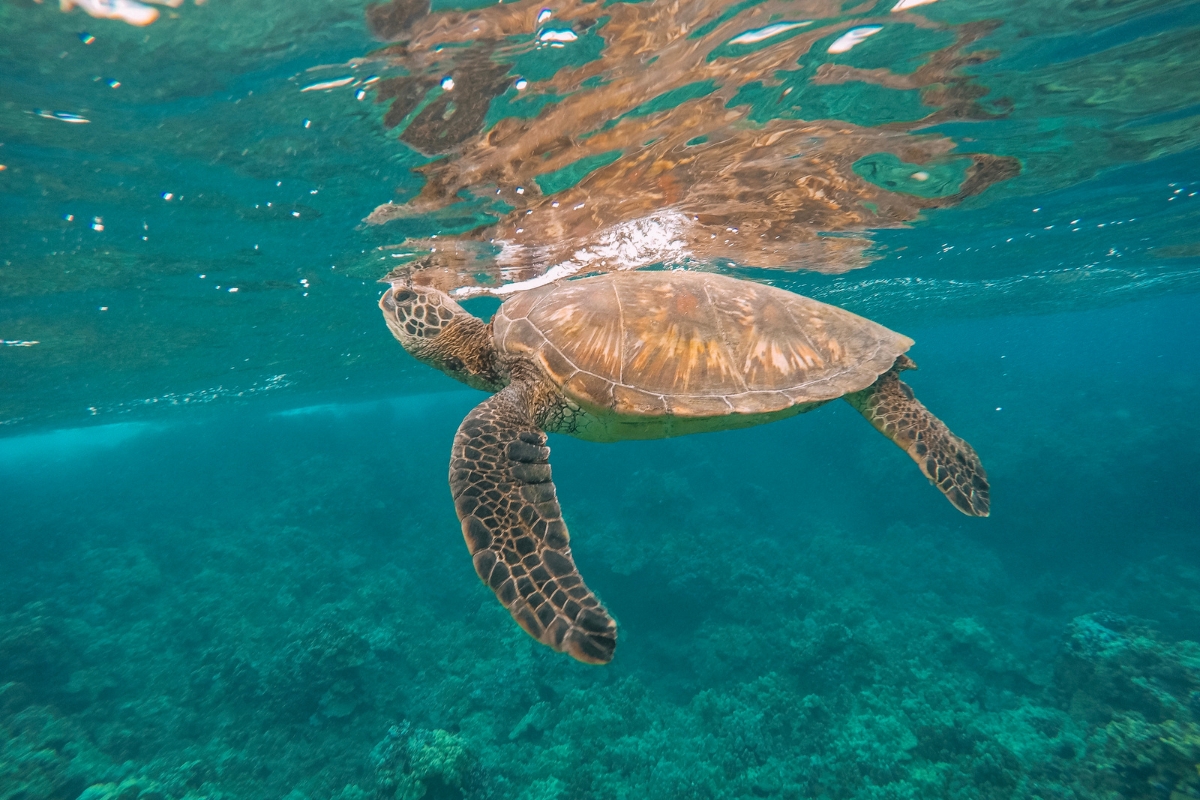
Plenty of people book Ecuador for the wildlife and come home talking about the water instead. They arrive with a checklist of animals and leave describing twenty minutes spent floating above a sea turtle that could not have cared less about them.
If reef time and mountain air already shape how you plan a holiday, this country fits you better than it fits the average visitor, and a lot of the trips to Ecuador sold as wildlife packages are really swimming trips with a volcano attached. Islands do most of the work here, though the mainland has its own cold lakes, long walks and slow afternoons.
Below is how to build the kind of trip where you spend more hours wet than dry, with one highland stop that earns its spot.
Isabela Island: Lava Tunnels, Penguins, and a Bay You Swim From Shore
Isabela is the largest island in the Galápagos and the one that rewards people who slow down. Puerto Villamil has sand streets, a short row of small hotels, and Concha de Perla, a mangrove inlet at the end of a wooden walkway where you can drop straight into the water from a platform. Sea lions usually get there first and will trail you around for a while, more curious than shy.
Rays pass underneath, penguins show up in the cooler months, and none of it costs a boat ticket. For something bigger, the Los Túneles site on the south coast is a maze of collapsed lava arches sitting in shallow water so clear it barely registers. Boats drop you for a walk across the arches, then a snorkel session where white tip reef sharks rest under ledges and turtles graze in the seagrass.
Dry days fill themselves too. Sierra Negra holds one of the widest volcanic craters in the world, and the route to the rim is a long walk rather than a climb, muddy after rain and worth doing early.
Santa Cruz: Tortuga Bay, Las Grietas, and the Walk That Gets You There
Santa Cruz is the busiest island in the group and still holds one of the best beaches in it. Tortuga Bay sits at the end of a paved path out of Puerto Ayora, roughly forty minutes on foot through cactus forest with no vehicles allowed. The first stretch of sand has heavy surf and marine iguanas stacked on the black rocks. Keep going to the far end and a sheltered lagoon opens up where the water hardly moves, which is where the snorkeling actually happens.
Las Grietas is the other favorite: a narrow flooded crack between two lava walls, reached by a short water taxi hop and a scramble over rock. Water in there mixes fresh and salt, cold in patches, deep enough that people jump from the ledges.
Puerto Ayora deserves an evening of its own. Fishermen clean the day’s catch at the pier while pelicans and sea lions crowd in for scraps, and the street behind fills with plastic tables and grilled fish once the light goes.

Guayaquil: The Coastal City Most Travelers Fly Straight Past
Almost every island flight connects through Guayaquil, and the city deserves more than one night near the airport. Malecón 2000 runs a couple of kilometers along the Guayas river with gardens, food stalls and a slow brown current that always seems to be carrying water hyacinth out to sea. At the northern end, a stairway of nearly 450 steps climbs Santa Ana hill past painted houses to a lighthouse looking over the port.
Parque Seminario in the center is known for the land iguanas living in it. They sit across the paths, climb into the trees, and accept mango from anyone holding a piece, which makes for a strange fifteen minutes on your first visit.
With a full day, Parque Histórico across the river pairs restored riverside architecture with a wildlife section holding sloths, tapirs and macaws. Humidity down here is a different beast from the islands, so push the walking into early morning and save the afternoon for shade.
Cuicocha: A Crater Lake in the Andes for Your Land Days
Ecuador rewards anyone willing to add a highland stop, and Cuicocha is the one to pick if lakes are your thing. Sitting around 3,000 meters below Cotacachi volcano, this crater filled with water after an eruption roughly three thousand years ago, leaving two forested islands in the middle that look, from the right angle, like a sleeping animal.
Boats loop those islands in half an hour and pass a corner where gas still bubbles up through the surface. Hikers can take the rim trail instead, a loop of about twelve kilometers with real elevation gain and long views across to Imbabura on clear mornings. Start at first light, because cloud tends to close in by midday.
Swimming is off limits here, so treat this as the reverse of your island days: cold air, thin oxygen, a packed lunch on a bench above the water. Cotacachi town below has hot almuerzos and cheap rooms if the weather turns and you decide to stay.
Timing the Water, the Boats, and What Goes in the Day Bag
Sea temperature in the Galápagos swings more than most people expect. June through November brings the cool Humboldt current, water near 20 degrees, more plankton and more big animals, which is when a shorty wetsuit stops being optional. December to May runs warmer and clearer, better for casual swimming and for anyone who gets cold fast.
Moving between islands means public speedboats, roughly two hours each way, often rough by afternoon. Book the morning crossings and take something for motion sickness before you board rather than after you regret it.
Bring your own mask if you have one. Rental gear on the boats fits badly and a leaking mask ruins an hour you paid a lot for. Reef-safe sunscreen, a rash guard and a dry bag cover most of the rest.
On the mainland, altitude matters more than distance. Highland towns sit well above 2,500 meters, so give yourself a slow first day before committing to any long walk.
