

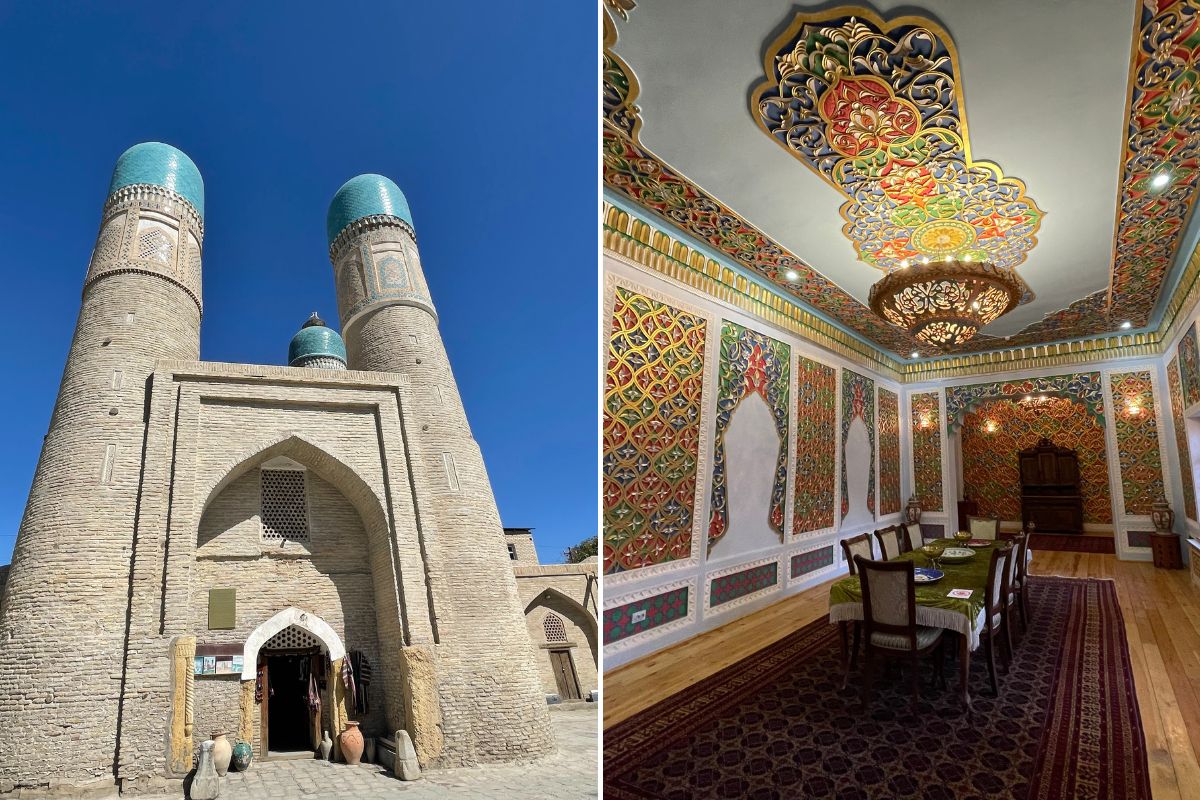
Uzbekistan is a former Soviet republic, located in the heart of Central Asia. Once a key hub along the ancient Silk Road, Uzbekistan has long served as a bridge between East and West, where trade caravans exchanged precious goods such as silk, cotton, gold, and spices.
Although not well known on the global tourism scene, this fascinating country has all kinds of cultural and historical experiences to offer to those looking for a new adventure.
As some of Uzbekistan’s cities have a history spanning over two millennia, the country’s deep roots in history have left behind a treasure trove of some of the world’s most spectacular medieval Islamic architecture, adorned with mesmerizing patterns and vibrant tilework.
Uzbekistan’s history has seen the rise and fall of countless empires, including the Persians, Arabs, Mongols, Timurids, and many more. This complex past has left its cities with a complex cultural heritage, shaped by long periods of peace and prosperous trade, as well as intense bouts of conflict.
Throughout these eras, entire populations were sometimes decimated, and significant architectural achievements were destroyed. Despite these challenges, many magnificent structures have survived, preserving the nation’s historical legacy.
From the stunning landmarks of Samarkand, Bukhara, and Khiva to the lesser-known gems scattered across the country, there are quite literally hundreds of impressive historical monuments to observe. Having lived here for 2 years, I can share with you 13 of the most beautiful places to visit in Uzbekistan, along with a few helpful tips for your travels.
Itchan Kala, Khiva

The Itchan Kala is the inner fortress of Khiva, an ancient city in west Uzbekistan, by the border with Turkmenistan. The fortress used to serve as protection against marauding Turkmen tribes and is today a UNESCO world heritage site. It holds dozens of religious buildings, palaces, boutique hotels, and a small number of restaurants within its 10m high walls.
It’s the most compact area of historical landmarks in all of Central Asia and offers wonderful views of the city from the watchtower of Kunya Ark fortress. You have to pay for entry to the Itchan Kala but at around $12 for a 2 day pass, it’s a bargain considering the number of world class monuments you can visit.
The Registan, Samarkand
The Registan is arguably the most iconic tourist attraction in Uzbekistan and the most visited in all of Central Asia. The term “Registan” means “sandy place,” and this particular site is surrounded on three sides by majestic madrasahs, or Islamic schools, the oldest of which dates back to 1417.
The three madrasahs go by the names of Ulugbek madrasah, Sherdor madrasah, and Tilla-Kori madrasah and together they stand defiantly above an expansive public square, typically under a bright blue sky.
Inside the madrasahs, you’ll discover courtyards, khudjras (cells) for students, and exhibits of artifacts. The Tilla-Kori Madrasah is the standout of the Registan with its inner mosque adorned in gold. Be sure to see its golden ceiling, which creates a stunning optical illusion.
Travel Tip: Whilst there are plenty of affordable places to stay in Samarkand, Bukhara, and Khiva, accommodation in Tashkent tends to be a bit more expensive. Booking in advance can help you secure a hotel at a reasonable price.
Shah-i-Zinda, Samarkand

Also located in Samarkand is the Shah-i-Zinda necropolis, a narrow corridor of blue-tiled mausoleums, which have amassed over the centuries into what has become Uzbekistan’s most instagrammable hotspot. Shah-i-Zinda, meaning ‘Living King’, refers to a cousin of the Prophet Muhammad, Kusam ibn Abbas, who moved to Samarkand in the 8th century to preach Islam.
He is believed to be buried here, as are the relatives of other significant figures such as Amir Temur and Ulugbek.

Travel Tip: Visit Shah-i-Zinda early in the morning to avoid crowds. As one of the most popular spots covering a small area, it can get crowded, making it challenging to take photos.
Lyabi Hauz, Bukhara

Lyabi Hauz, meaning ‘by the pond’ in Persian, is a picturesque rectangular-shaped pool, surrounded by religious buildings and waterside restaurants. It’s a mini hub of activity, located close to the trading domes, rug stores, and street vendors. In my personal opinion, it is the most beautiful spot in Uzbekistan.
Lyabi Hauz was constructed in the early 17th century and was a popular area even before then, known for its entertainers such as musicians, magicians, and even snake charmers. These days you’re unlikely to find any snake charmers but you can still enjoy live music in the evenings.
It’s the perfect spot to enjoy grilled kebabs, known in Uzbek as shashlik with a glass of wine as the sun starts to set.
Travel Tip: The best way to travel around the main cities of Uzbekistan is by Afrasiyab speed train. It’s comfortable, fast, and very affordable.
TV Tower, Tashkent

There aren’t so many obvious things to do in Tashkent for tourists but a trip to the TV tower is definitely worthwhile.
While not as visually stunning as other landmarks on this list, the tower offers a beautiful view of Uzbekistan’s capital city. The tower provides impressive panoramic views, especially in the spring and summer evenings on a clear day. Sunsets in the city can be a vibrant blend of orange, pink, and red hues.
The tower is 375m high and has two levels of observation decks. Its upper deck has a rotating restaurant, from which you can enjoy great views of the city whilst enjoying a coffee or a glass of wine.
Travel Tip: Despite Uzbekistan’s Muslim majority, alcohol is common at bars, restaurants, hotels, and stores. Vodka’s popular, but beer, wine, and other spirits are also abundant. Tea’s a favorite non-alcoholic option!
Khan Palace, Kokand

Constructed under the orders of Khudayar Khan, the four-time ruler of the Khanate of Kokand, this palace originally had over 100 rooms. A significant portion of the palace was used as living quarters for the Khan’s harem.
Khudayar Khan’s time in this beautiful palace was brief, as he had to flee to Russia during a local uprising. Only 19 rooms remain today, including the stunning throne room with its dazzling ceiling. Elsewhere in the palace, you’ll find more unusual rooms, such as one filled with stuffed animals and another showcasing a collection of European art and sculptures.

The palace is situated within a picturesque grassy park in the heart of the city and is best appreciated from the east side. From this vantage point, you can see the Arabic script above the entrance that reads ‘Sayid Muhammad Khudayar Khan – Great ruler.’
Kalon Mosque and Minaret, Bukhara

One of the longest-standing monuments in the center of Bukhara is the Kalon Minaret, built in 1127. It was spared from destruction by Genghis Khan while his men razed the city after the 1220 siege of Bukhara. The local population were either slaughtered or kept as slaves but it is said that the minaret impressed Genghis Khan so much that he ordered it to remain.
The adjacent Kalon Mosque was destroyed by the army, but it was rebuilt and completed in the 16th century. It features a vast inner courtyard surrounded by an arched gallery topped with domes and supported by 208 columns, showcasing intricate geometric designs.
Ak-Saray Palace, Shahrisabz
Shahrisabz, near the birthplace of the infamous Amir Timur, offers a day trip opportunity from Samarkand to explore the ruins of the Ak-Saray Palace, the city’s centerpiece. Though the palace, once part of Timur’s grand residence, is largely in ruins, it features impressive entrance pillars and remnants of opulent courtyards with gold and colored tile decorations.
The restored remains now serve as a cultural park and host art festivals, celebrating the region’s heritage; the palace is part of the UNESCO World Heritage List.
Chor Minor, Bukhara

One of the most distinctive landmarks in Bukhara is the Chor Minor Madrasah, a structure featuring four squat minarets topped with turquoise domes at its corners, each adorned with unique decorations.
Set inside a quaint garden with an artificial pool reminiscent of Lyabi Hauz, the Chor Minor madrasah is a 10 to 15 minute walk from the center of the old city. It is hidden in a peaceful, traditional neighborhood area, where local children often play in its grounds.
Bolo Hauz, Bukhara

Bolo Hauz, located opposite the Ark Fortress, was designed for use in both winter and summer. The 20-pillar iwan, added in the early 20th century, offers shaded summer worship and overlooks an octagonal pond. Known as the “40-pillar mosque” due to its reflection in the pond, Bolo Hauz also provided a water source for the community, though this use was halted under Soviet rule.
Today, the mosque is open for worship and impresses visitors with its beautiful interior. I visited at night when the mosque becomes illuminated in green and yellow light, giving it a mysterious glow.
Zaamin National Park, Jizzakh
Known as “Uzbekistan’s Switzerland,” Zaamin is a national park and nature reserve on the Turkistan Mountain Ridge near Tajikistan. Renowned for its clean air and stunning views, it is a favorite destination for locals seeking rejuvenation. Zaamin also houses a sanatorium that treats respiratory illnesses, offering a healing setting amid the park’s serene beauty.
Zaamin National Park was established in 1976 to preserve juniper forests and spans 24,000 hectares, with 16.7 thousand hectares covered in various juniper species. The park is home to a diverse flora, including over 700 plant species like bindweed, Turkestan hawthorn, geranium, carnation, and tarragon.
The park’s ancient juniper trees form dense thickets, while the fauna includes wolves, Siberian ibex, Tolai hares, porcupines, martens, and steppe polecats. It also hosts various birds like owls, blackbirds, and turtle doves, along with predators such as white-clawed bears, Turkestan lynx, and even reported sightings of snow leopards.
The park features a couple of hotels, and in 2023, a suspension bridge was built that allows visitors to experience the valley from a height of 150 meters.
Pahlavan Mahmud Mausoleum, Khiva

Pahlavan Mahmud was an Iranian-born poet, philosopher, and wrestler known for his good deeds. He became the patron saint of Khiva in 1810, roughly 500 years after his death. His mausoleum in Khiva’s Itchan Kala began as a simple tomb but transformed over time, especially after his elevation to sainthood, into one of the city’s most stunning interiors.
According to a legend, Pahlavan Mahmud defeated an Indian ruler who offered him any reward he desired. Pahlavan Mahmud requested the release of his countrymen from prison. To fulfill the request, the ruler asked how many people should be released, and Pahlavan Mahmud responded that it should be all those who would fit into a cow skin. He cut the cow skin into thin strips and used them to tie together all the prisoners into one large belt, thereby securing the release of many people from slavery.
Upon entering the courtyard, the chamber to the left is the most beautiful room in Pahlavan Mahmud’s mausoleum. It contains the tombs of Isfandiyar Khan’s mother and son. Although Isfandiyar Khan, who ruled Khiva between 1910 and 1918, was supposed to be buried there, he was executed outside the fortress at Nurullabay Palace.
Nurullabay Palace, Khiva

Nurullabay Palace, also known as Isfandiyar Palace, offers a glimpse into the luxurious lifestyle of the khans and emirs of Uzbekistan. Built with the help of skilled craftsmen, the palace conveys the history of Khiva in the late 19th and early 20th centuries with its splendid design and unique features.

Highlights include ceilings decorated with gold, precious stones, and peacock feathers, as well as Chinese porcelain, German furniture, and luxurious chandeliers. The palace’s restoration to its original form preserves its beauty, making it a must-visit destination.
It is one of Khiva’s lesser-visited sites, but it should be on every tourist’s list due to its unique character. The palace had an eerie atmosphere when I walked through its halls in silence, as I was the only visitor there. This haunting ambiance would make it the perfect location for a horror film!
Final Thoughts
Uzbekistan is certainly one of the world’s more off-the-beaten-path destinations, but these are just some of the hundreds of beautiful places waiting to inspire you.
From the ancient wonders of Khiva to the majestic Registan in Samarkand or the mountains of Zaamin, there is something to impress every type of traveler.
Author Bio
Ryan Ettenfield is a travel writer, independent journalist, and creator of tourcentralasia.com, a website aimed at sharing the hidden gems of Central Asia and the Silk Road. When not frantically using a thesaurus, he can be found teaching maths, running around Tashkent parks, or sipping a cold bland beer.